The carbon clean-up: why reaching 'zero' may not be enough
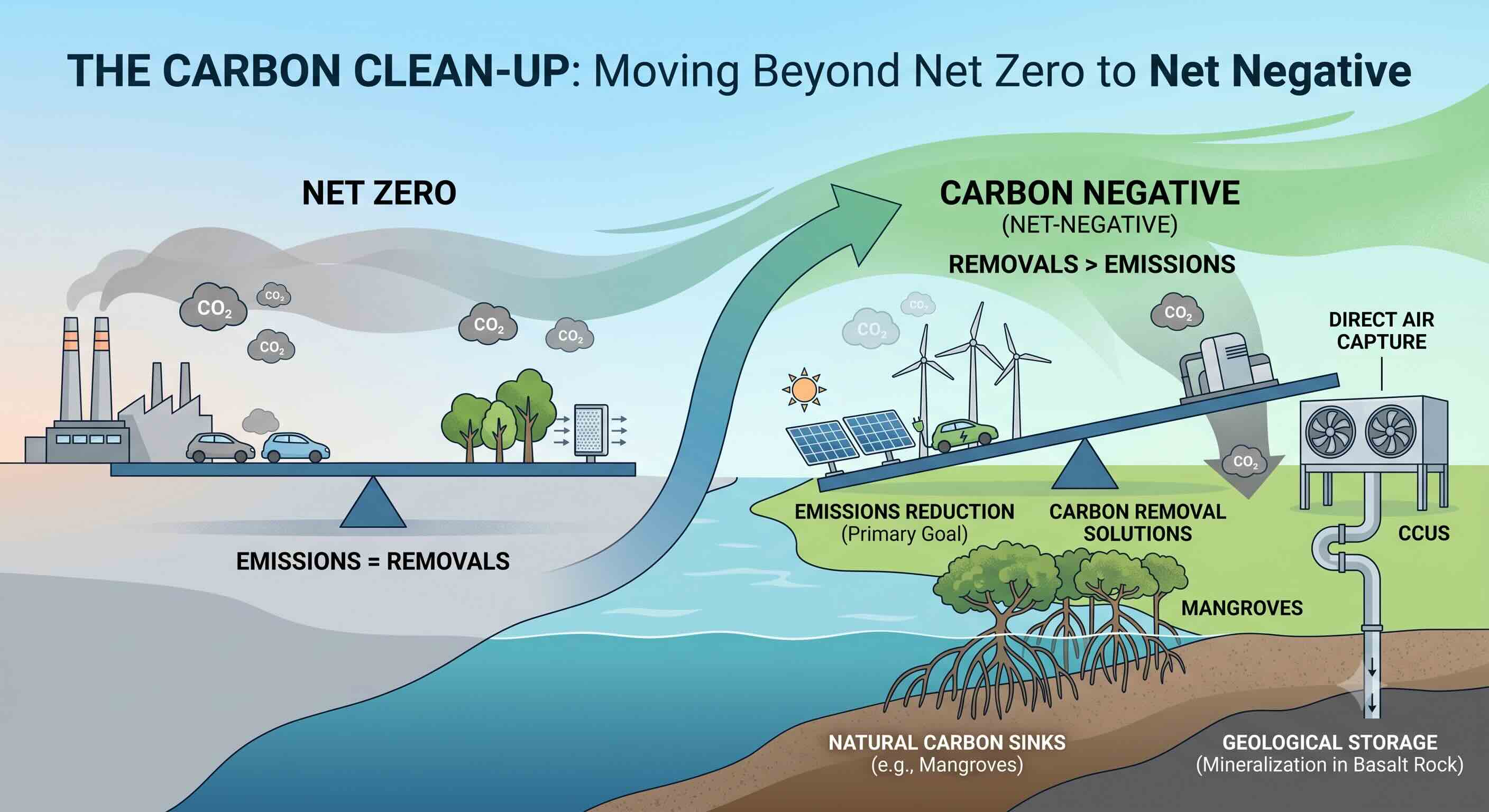
For years, net zero has been the gold standard for corporate climate pledges. But as the science sharpens, the next phase of climate action is coming into focus: cutting emissions rapidly and developing ways to remove the carbon dioxide already in the atmosphere.
If we eventually want to bring atmospheric CO₂ concentrations down (and, over the long run, ease global temperatures back after reaching net zero), global carbon removal will likely have to play a part. In other words, balancing emissions may not be the final destination. Some level of net-negative CO₂ emissions could be needed over the long term.
At the same time, carbon strategy is maturing from a public-relations exercise into a core business issue. From technology firms managing climate risk to heavy manufacturers preparing for lower-carbon supply chains, investment in carbon removal and carbon management is increasingly tied to regulation, financial planning, and competitive advantage.
Below, I walk through the science, the technologies, and the business strategies shaping this next phase.
The maths: neutral vs. negative
The difference between corporate climate goals comes down to the balance between the greenhouse gases a company emits and the greenhouse gases it removes.
Net zero
Net zero means the greenhouse gas emissions from human activity are balanced by removals over a defined period. A company may still emit CO₂, but it has to cut emissions as far as possible and neutralise the unavoidable remainder through verified removals.
Historically, many companies leaned heavily on carbon offsets, forestry projects among them, but growing scrutiny has pushed them towards higher-quality removal. Net zero, in essence, is reaching a balance: what's added to the atmosphere is matched by what's taken out.
Carbon negative (net negative)
A carbon-negative company removes more CO₂ than it emits. Rather than only halting additional warming, net-negative emissions can help draw down atmospheric CO₂ over time. That doesn't mean the planet cools immediately; climate systems respond gradually, and temperature is shaped by many greenhouse gases and other factors at once.
To get there, companies depend on Carbon Dioxide Removal (CDR), which today falls into two broad categories: natural carbon sinks, and engineered removal technologies.
Net zero is a milestone, not the finish line; the harder question is what we do about the carbon already in the air.
The two faces of carbon removal
Natural sinks: nature's carbon storage
Long before we engineered anything, ecosystems were already capturing and storing carbon. Forests, wetlands, grasslands, and oceans all act as natural sinks. Among the richest are blue carbon systems: mangroves, tidal marshes, and seagrass meadows.
Mangroves are especially effective, storing carbon not only in their vegetation but in the oxygen-poor soils beneath them. Some studies estimate mangrove ecosystems hold several times more carbon per hectare than many tropical forests, largely thanks to carbon-rich sediment. The mechanism is simple: organic material gets trapped in waterlogged soil where a lack of oxygen slows decomposition, letting carbon stay locked away for centuries or longer.
The catch. Natural sinks are relatively cheap and bring major biodiversity benefits, but they're vulnerable. Clear a forest, drain a peatland, or destroy a mangrove, and much of the stored carbon can eventually return to the atmosphere. Protecting these ecosystems is essential, yet natural sinks alone can't reliably remove enough carbon to cover every remaining emission.
Technological sinks: engineered removal
To complement nature, engineers are building systems to pull CO₂ straight from the air or from industrial processes. The most prominent is Direct Air Capture (DAC).
DAC facilities work a little like industrial trees: large fans draw ambient air through chemical filters that selectively grab CO₂, which is then separated from the filter and either stored underground or used in products. Because atmospheric CO₂ sits at only around 432 parts per million, roughly 0.04% of the air (per NASA's latest measurement), DAC systems have to move enormous volumes of air to capture a meaningful amount.
Geological storage. Captured CO₂ can be injected deep underground into suitable formations such as saline aquifers or depleted oil and gas reservoirs. In some places with reactive basalt rock (as in projects developed by Carbfix in Iceland), dissolved CO₂ reacts with minerals and becomes permanently locked as solid carbonate rock. Not all storage works through rapid mineralisation, though; many projects rely on geological trapping designed to keep CO₂ isolated for thousands of years.
The catch. DAC is technically promising but, for now, expensive and energy-intensive. Its future depends on bringing costs down, expanding clean energy supply, and proving storage is genuinely permanent.
The business of removal
If carbon removal is expensive, why are companies buying it? The answer depends largely on their emissions profile.
Path A: tech, retail, and services buy removal
Software companies, financial firms, and professional-services businesses tend to have fewer direct industrial emissions. Their footprint usually comes from electricity, data centres, buildings, transport, and supply chains. For them, buying high-quality carbon removals is a way to address residual emissions that can't be eliminated immediately.
Higher-quality claims. In the past, many firms leaned on inexpensive offsets, including some forestry projects. A number of these have drawn criticism over additionality, permanence, and measurement. That doesn't make all nature-based projects ineffective; well-designed ecosystem protection and restoration can deliver real climate benefit. But companies are increasingly seeking removals with stronger verification and longer storage.
Market leadership. Companies including Microsoft and Google have signed large carbon-removal agreements. Purchases like these help build an emerging removal market while signalling climate commitment to investors, customers, and staff.
Managing future cost. Long-term removal contracts can also be a form of risk management: buying today may hedge against future carbon regulation or rising demand for limited removal capacity.
Path B: heavy industry uses CCUS
For cement, steel, and chemicals, eliminating every emission is far harder. This is where Carbon Capture, Utilisation and Storage (CCUS) matters. Unlike DAC, which pulls CO₂ from the open air, CCUS captures concentrated CO₂ from industrial facilities before it escapes.
Why heavy industry needs it. Some emissions can't be removed by switching to renewable electricity alone. Cement is the classic case: a large share of its emissions comes not from burning fuel but from the chemical breakdown of limestone into clinker, which releases CO₂ as part of the process itself. For these sectors, capture may be one of the few available routes for dealing with genuinely unavoidable emissions.
Creating value from captured carbon
Captured CO₂ can sometimes become a product in its own right: synthetic fuels, industrial chemicals, carbonated products, mineralised concrete. Some CO₂-curing and mineralisation methods can even improve concrete while permanently storing carbon, though the benefit depends heavily on the specific technology and application.
Incentives and carbon markets
Governments are increasingly using financial incentives to speed up capture and removal.
In the United States, the Section 45Q tax credit is the primary federal support for CCUS. Its value depends mainly on the capture technology and on whether the project meets eligibility requirements. For projects meeting prevailing-wage and apprenticeship requirements, current maximum credits include:
- Up to $85 per tonne for eligible point-source capture.
- Up to $180 per tonne for eligible direct air capture.
Since 2025, CO₂ that is utilised, including in enhanced oil recovery or converted into products, generally qualifies for the same value as CO₂ placed in dedicated geological storage; earlier projects faced lower rates for utilisation. Eligibility still turns on the specific project design and regulatory framework, and credit amounts are scheduled to adjust over time under inflation rules.
In regions with carbon pricing, such as the European Union, capture can cut compliance costs. Under the EU Emissions Trading System, CO₂ that is captured and permanently stored may not require companies to surrender allowances for those tonnes, provided the storage meets regulatory requirements.
The golden rule: capture must not become an excuse to pollute
Carbon capture is not a substitute for cutting emissions. The strongest strategies follow a clear hierarchy:
- Avoid and reduce emissions wherever possible.
- Improve efficiency and cut energy demand.
- Switch to clean electricity and low-carbon technologies.
- Then use CCUS or DAC, only for emissions that remain genuinely hard or impossible to eliminate.
Capture is particularly valuable in cement, chemicals, and some industrial processes. But many experts argue that using CCS to extend the life of fossil-fuel power generation is often less effective than simply replacing those plants with cleaner alternatives, especially where renewable electricity and storage are already available.
Moving beyond zero
No single technology will solve climate change. The strategy that works will be a combination: rapid emissions cuts, renewable deployment, ecosystem protection, industrial innovation, and responsible carbon removal.
Net zero remains a critical milestone. But for the world to eventually bring atmospheric CO₂ down, removal will likely become an important part of the toolkit. The key is to treat it as a targeted solution for residual emissions, never as a substitute for cutting pollution at its source.
See it for yourself
The balance this piece describes is easier to feel when you can move the pieces yourself. In the model below, adjust emissions, natural uptake, and engineered removal, then watch atmospheric CO₂ and the global temperature respond, along with where that leaves the Paris targets. The figures are illustrative: an educational model, not a projection.
Carbon Flow Simulator
How emissions and carbon removal affect atmospheric CO₂ and global temperature.
Educational model only. Uses IPCC best-estimate climate sensitivity (ECS 3°C per CO₂ doubling). Pre-industrial baseline: 280 ppm / +0°C. Real sinks currently absorb ~50% of emissions. Sources: NOAA, IPCC AR6, Global Carbon Project.
Adjust Parameters
Global Temperature Anomaly
Working on something in this space? I'd be glad to compare notes. Get in touch.