What a Political Scientist Sees in a Carbon Accounting Standard
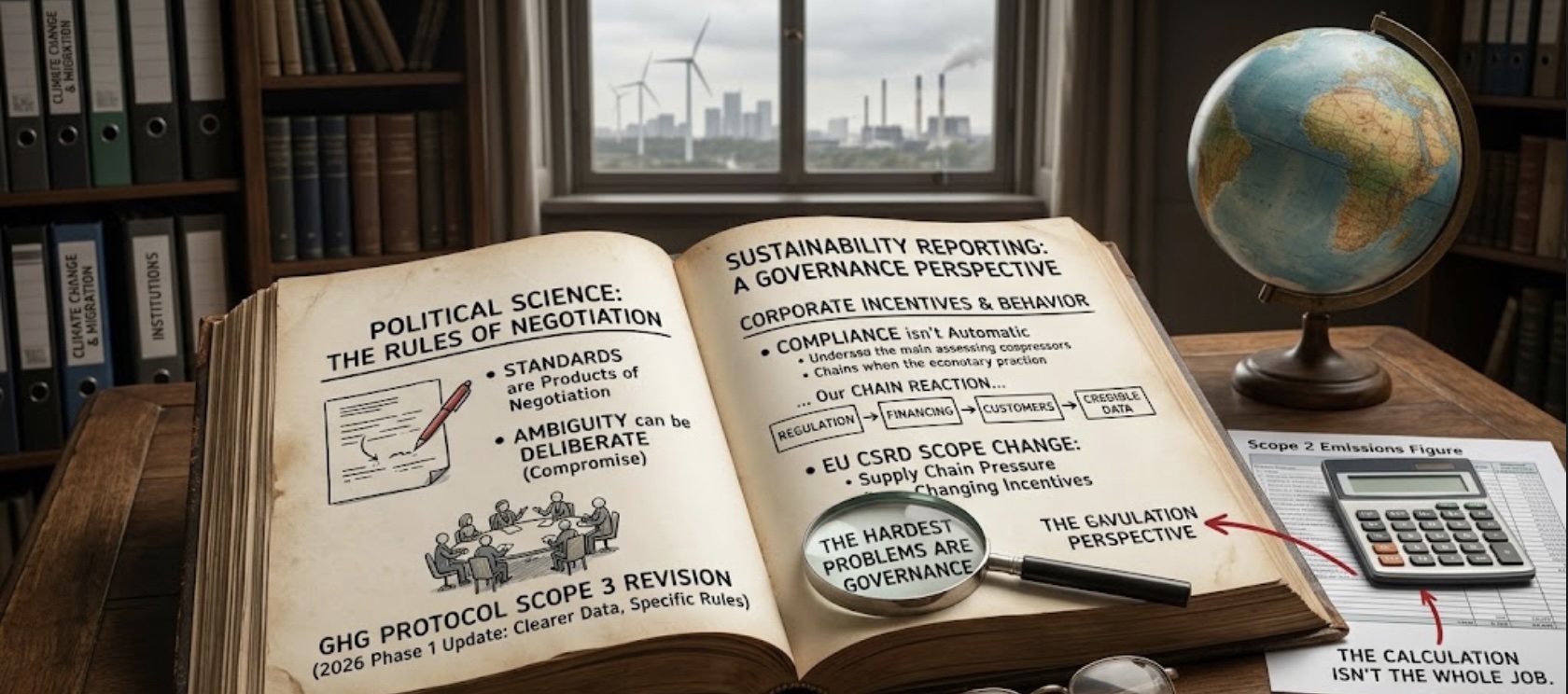
My doctorate is in political science, focused on climate change and migration. It did not teach me how to calculate a Scope 2 emissions figure.
But it did teach me something that has turned out to be very useful in sustainability reporting: how to read rules and standards as products of negotiation, institutions and competing interests.
That matters because standards are not written in a vacuum. People draft them, stakeholders disagree, compromises are made, and the final wording reflects those choices.
Once you start reading standards that way, some of their strange or vague wording starts to make more sense.
Ambiguity can be deliberate
When a technical document is vague, it is easy to assume the writing is simply poor.
But in a negotiated standard, vague wording can sometimes be intentional.
Different groups may disagree about how strict a requirement should be. Instead of choosing one side, the standard may use flexible language that everyone can live with.
That does not mean every vague sentence is the result of a political compromise. But it does mean ambiguity is not always a mistake.
It can also tell you something about where a standard might change in the future.
If companies interpret a flexible rule in very different ways, regulators or standard setters may eventually decide that clearer requirements are needed.
You can see this in the current revision of the GHG Protocol Scope 3 Standard.
The March 2026 Phase 1 Progress Update describes proposals that are still being developed. It is not yet the formal public consultation draft.
Among the ideas being considered are clearer requirements for showing what type of data companies use and a more specific rule on how much of their Scope 3 emissions they need to include.
The existing 2011 standard already has rules about data quality, data sources, and exclusions. So these ideas are not starting from nothing.
What the proposed changes would do is make some parts of the existing system much more specific and easier to compare between companies.
That is an important distinction.
The lesson is not that old standards had no rules. It is those areas that, once allowed, more judgment can later become more prescriptive.
Compliance is about incentives too
Political science also teaches you that writing a rule does not automatically change behaviour.
Companies respond to rules, but they also respond to enforcement, reputation, customers, investors, lenders, and commercial pressure.
A reporting requirement may create the obligation to disclose information.
But that information often becomes much more important when someone actually uses it to make a decision.
For example, if emissions data starts affecting financing, procurement, or customer relationships, companies have a stronger practical reason to make sure the data is credible.
That is why I think the recent changes to the EU's Corporate Sustainability Reporting Directive are interesting.
The revised rules significantly narrow the number of companies that fall directly within the main reporting requirements.
That is usually described as a reduction in reporting burden.
And it is.
But it also changes which companies are directly inside the regulatory system and which companies are outside it.
That can affect the pressure that moves through supply chains, because large companies often ask suppliers for information even when those suppliers are not directly covered by the law.
So changing the scope of a regulation can change more than the number of companies that have to file a report.
It can change the incentives around the whole system.
Organisations forget why they do things
Another useful political-science habit is asking why a rule or practice exists in the first place.
Organisations often keep doing something long after the original reason has been forgotten.
Emission factors are a simple example.
Someone may choose a particular factor for a perfectly reasonable reason.
Years later, the number is still sitting in the spreadsheet, but nobody remembers who chose it or why.
Eventually, it stops being a decision and becomes part of the infrastructure.
The same thing happens with much bigger institutions.
A policy or process may continue because it is already there, not because anyone has recently checked whether it still makes sense.
The solution is simple in principle: record the reasoning.
Write down why a decision was made, who made it, what evidence was used, and when the decision should be reviewed.
That makes it much easier to change things deliberately later.
Why this matters for sustainability reporting
Sustainability reporting is often treated as a technical discipline.
And of course, there is technical work involved.
But I have come to think that many of the hardest problems are really governance problems.
The calculation itself may be simple.
Use an activity figure. Apply an emission factor. Get a result.
The difficult questions usually come before and after that calculation.
Who owns the data?
Which source should we trust?
What happens when two departments disagree?
How good does the data need to be?
Who is responsible for checking it?
Why does the standard require this particular thing?
How much judgement are we allowed to use?
And how might the rule change in the future?
Those are not mainly mathematical questions.
They are questions about institutions, incentives, responsibility and trust.
In other words, they are political-science questions.
I did not expect my academic background to be so useful in sustainability reporting.
But it makes more sense to me now.
Standards are created through governance processes. Organisations contain different interests and incentives. Reporting depends on people agreeing about rules, evidence and responsibility.
So sustainability reporting is not just about calculating emissions.
A large part of the job is understanding the system around the calculation.
Working on something in this space? I'd be glad to compare notes. Get in touch.